Open to Winter 2026 & Summer 2027 internships & co-ops

Caleb James
IT/Cybersecurity Student & Aspiring Security Analyst

Protecting what matters most. I'm an IT/Cybersecurity student at George Mason University, spending my time between coursework, home labs, undergraduate research, and CYSE Competitions, learning how attackers move so I can get better at stopping them before they strike.

Fairfax, VA — George Mason University Open to Internships and Co-ops

About

Security Work Summary

I'm an IT & Cybersecurity student at George Mason University, splitting my time between cybersecurity coursework, home-labs, undergraduate research, and CYSE competitions on the side. I like work that delves into theory and practice. Reading about an attack technique in class, then rebuilding it myself in a home lab to see exactly how it works.

As an undergraduate student pursuing cybersecurity, I have developed a strong foundation in securing IT systems through hands-on coursework, labs, and independent projects. My experience includes performing vulnerability assessments, system configuration, analyzing network traffic, implementing security best practices, and strengthening system defenses against common cyber threats. I am familiar with essential technologies such as Windows and Linux administration, networking fundamentals, firewalls, access control, and security monitoring tools. Through practical experience with scripting, virtual lab environments, and security frameworks, I have built problem-solving skills and a security-first mindset. I am committed to constantly expanding my technical knowledge to defend systems and data.

  • 2028Expected Graduation
  • 8+Competition/Challenges Completed
  • 4Home-Lab Environments Built
  • 4Active Certifications

Skills

Toolkit

Grouped by where and how I use them. My active certifications are included.

Offensive security

  • Burp Suite
  • Metasploit
  • Nmap
  • Cobalt Strike
  • BloodHound
  • OWASP ZAP

Defensive & SOC

  • Splunk
  • CrowdStrike Falcon
  • Wireshark
  • Sigma rules
  • MITRE ATT&CK
  • Elastic Stack

Cloud & infrastructure

  • AWS security
  • Azure AD
  • Terraform
  • Linux hardening
  • Python
  • Bash
  • Cisco Packet Tracer
  • MySQL
NSE 1 - Fortinet Cybersecurity & Cloud NSE 2 - Fortinet NextGen. Firewall NSE 3 - FortiGate 7.6 Operator AZ-900 - Microsoft Azure Fundamentals (in progress)

Projects

Projects

A list of my selected works & most relevant project information. Each write-up covers the problem, solution process, results, and what came out of it. Project code is available on GitHub.

Building a vulnerable Active Directory home lab

Tools: VirtualBox, Windows Server 2019, Kali Linux, BloodHound, Mimikatz

Problem
The objective of this home lab was to identify and exploit common Active Directory misconfigurations, analyze attack paths using BloodHound, and observe how these weaknesses could lead to a full domain compromise.
Steps
Built a lab with a domain controller and two workstations, deliberately introduced common misconfigurations, such as a Kerberoastable service account, unconstrained delegation, and weak GPO permissions. Then, used BloodHound to map the resulting attack paths and Mimikatz to carry out a full domain compromise.
Result
Documented three separate paths to Domain Admin and wrote a home lab guide that two classmates later used to build and study their own labs.
What I learned
Reading about Kerberoasting and watching BloodHound draw the attack graph are two very different levels of understanding. Visually seeing the path was helpful.
Placing in the National Cyber League Fall competition

Tools: Burp Suite, CyberChef, Ghidra, Wireshark, Python

Problem
The objective of this competition was to strengthen practical cybersecurity skills by solving challenges in web exploitation, digital forensics, cryptography, log analysis, and network packet capture.
Steps
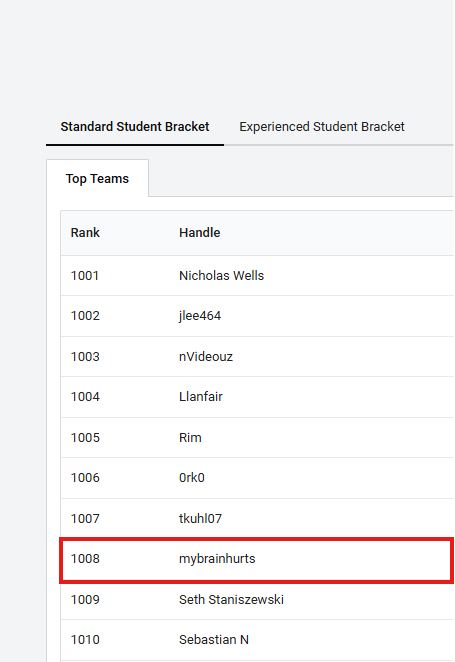
Competed in the National Cyber League's Fall Individual Game across categories including web exploitation, forensics, and cryptography, putting extra practice time into log analysis and packet capture challenges, the categories I was weakest in going into the season.
Result
Finished in the top 25% nationally, with a full score in the forensics category.
What I learned
Packet capture analysis got dramatically faster once I built a personal checklist for what to check first in Wireshark instead of scrolling through the whole capture looking for anomalies.

Signal Deck: building a mini SIEM and SOC detection pipeline

Tools: Python, SQLite, Regex, MITRE ATT&CK Framework, HTML dashboard

Problem
The objective of this lab was to build a complete detection pipeline from raw logs to analyst dashboard, and to measure honestly how well the detection rules performed against known attacks.
Steps
Generated three days of synthetic Windows, Linux, and firewall logs with 16 labeled attack campaigns hidden in benign traffic. Wrote a collector that normalizes three raw log formats into SQLite, then built eight rule-based detectors (brute force, suspicious PowerShell, port scans, impossible login, privilege escalation, new admin accounts, persistence, large outbound transfers) mapped to MITRE ATT&CK. Scored the alerts against a hidden answer key and rendered the results in a dashboard.
Result
Detected all 16 campaigns (100% recall) with 0.97 alert precision and a 0.98 F1 score. The one false positive came from two detectors firing on the same event.
What I learned
Evaluation code needs as much scrutiny as detection code. A naive matching rule misattributed an alert and created a false negative until I switched to nearest-in-time matching, and the duplicate-alert case showed why real SIEMs correlate alerts into incidents.

MITRE ATT&CK Chain Simulator: a browser-based cyber range

Tools: JavaScript, HTML, CSS, MITRE ATT&CK Framework

Problem
I wanted a safe way to show how layered security controls change whether an attack chain gets caught, without touching a real network, host, or account.
Steps
Built a self-contained web app with three scenarios (phishing-led compromise, ransomware staging, insider misuse), each mapped to MITRE ATT&CK tactics and technique IDs. Users toggle simulated controls such as email gateway, EDR, MFA, SIEM correlation, firewall/IDS, and DLP, then run a six-stage kill chain that is scored by a per-stage detection-probability model.
Result
Delivered a single-file, no-dependency simulator with a live sensor log and a per-tactic detected/undetected results table, and it can be hosted directly on GitHub Pages.
What I learned
Mapping each stage to ATT&CK tactics made defense-in-depth concrete: no single control catches everything, and the gaps show up in the stages between them.

Rep-Right: Real-Time Exercise Form Feedback in the Browser

Tools: JavaScript, TensorFlow.js, MoveNet, HTML5 Canvas, WebRTC

Problem
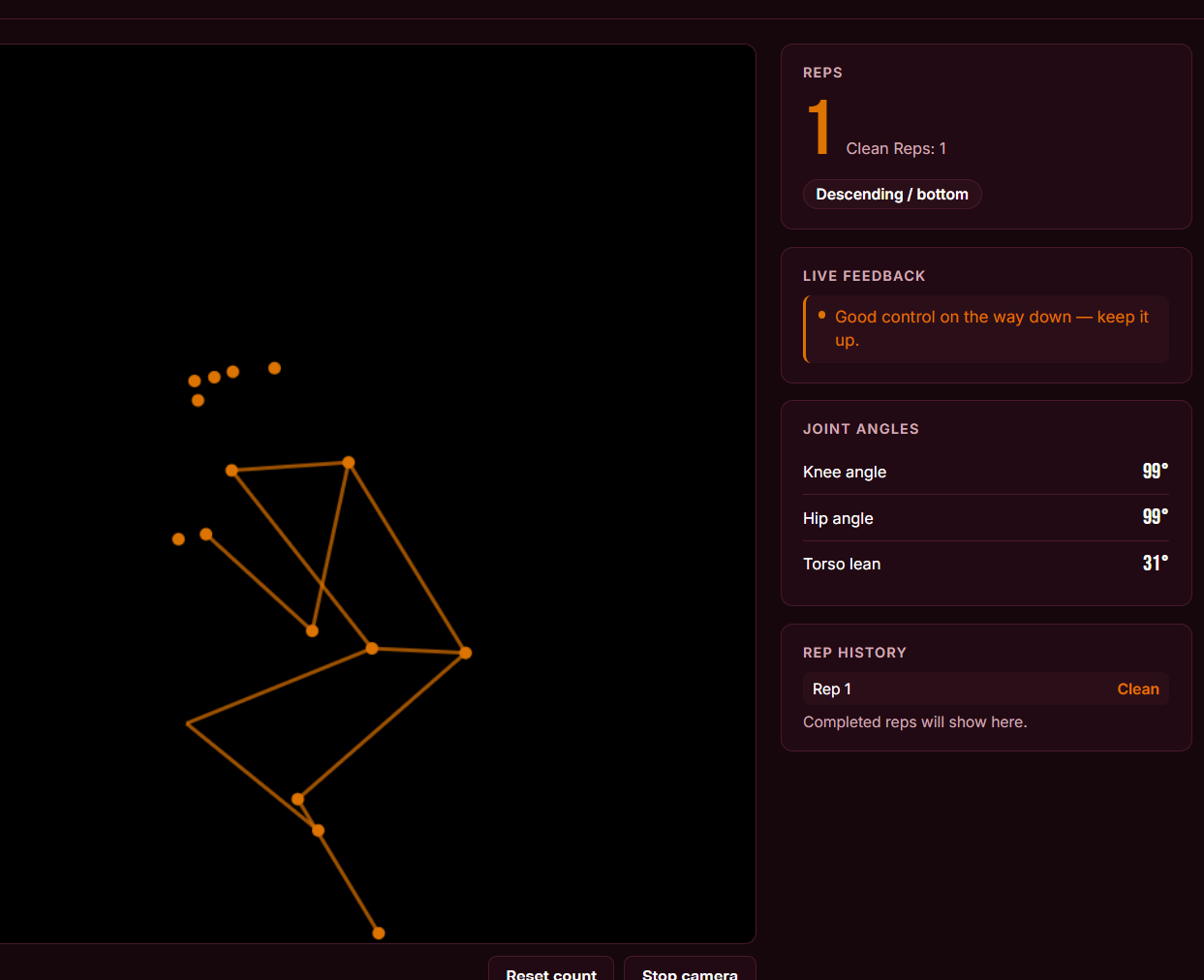
This project was originally made for the VTHacks 12 Virginia Tech Hackathon. I co-developed this tool with a couple of other student developers. We wanted to see if a browser alone, without any backend, account, or uploaded footage, could watch someone through their webcam and tell them in real time whether their lifting/exercise form was correct.
Steps
Built the app around TensorFlow.js's MoveNet model to pull 2D body keypoints from the live webcam feed at roughly 30fps, then wrote the geometry layer including functions to compute joint angles and torso lean from vertical using vector dot products. Wrote a separate analyzer per exercise (squat, push-up, lunge, plank) that picks the more visible side of the body, checks for that exercise's specific faults (knee valgus, hip sag or pike, excessive torso lean, knee traveling past the toes). For rep-based exercises, built a small phase state machine (up/down) with hysteresis thresholds so a rep only counts once the joint angle crosses back through a "top" threshold, and flagged reps as "clean" or logged their specific issue.
Result
Won the Peraton sponsor’s “Best Implementation of Generative AI” award.
What I learned
Turning noisy per-frame angle data into a stable rep counter was difficult, but adding an EMA filter helped remove a lot of the noise. I learned that for any live sensor-driven state machine, the signal-processing step matters as much as the domain logic sitting on top of it.

Experience

Experience & Involvement

  1. 2024 — 2025

    Artificial Intelligence Undergraduate Researcher · Virginia Tech IDEEAS Labs

    Conducted extensive research with a team on artificial intelligence, LLM models, and nationwide policies regarding its use, culminating in an AI-powered website database of national institutional AI policy and a 150+ page research paper.

  2. 2026 — Present

    Web Developer · The Forge

    Web Developer with the nationally acclaimed, award-winning student-run magazine, The Forge! Developing multiple websites and web applications with PHP, HTML, CSS, JavaScript, WordScript, WordPress, etc.

  3. 2026

    SEO & Website/Marketing Optimization· Private Author

    Conducted Search Engine Optimization, prevented malicious redirects and search engine blacklisting, and improved website performance and accessibility as freelance work for a private author.

  4. 2025 — Present

    Member · Mason Competitive Cyber Club

    Compete in the club's CTF competitions and help lead bi-weekly CTF practice sessions for newer members, covering categories from web exploitation to network forensics.

Contact

Let's talk

Fastest way to reach me is email. I'm also active on LinkedIn and keep my project code on GitHub.

Let me know what role or project you're reaching out about.